


Zinc vs Aluminum Die Casting: Advantages and Use Cases
Zinc die casting and aluminum die casting are high-pressure molding processes that form metal parts by injecting molten zinc or aluminum alloys into steel dies, with each alloy offering distinct material and performance characteristics. Choosing between these two methods requires you to balance the need for part strength and weight against requirements for dimensional precision and production speed. While aluminum is favored for lightweight structural components, zinc offers unmatched fluidity for intricate, tight-tolerance parts. This guide breaks down the essential technical differences to help you make an informed manufacturing decision.
What Are Zinc and Aluminum Die Casting?
Zinc die casting and aluminum die casting are high-pressure molding processes that form metal parts by injecting molten zinc or aluminum alloys into steel dies, with each alloy offering distinct material and performance characteristics. You use these processes to produce complex metal components with high repeatability and professional surface finishes. The fundamental difference lies in the equipment used; zinc is typically cast using "hot-chamber" machines for speed, while aluminum requires "cold-chamber" machines to prevent the alloy from damaging the injection mechanism.
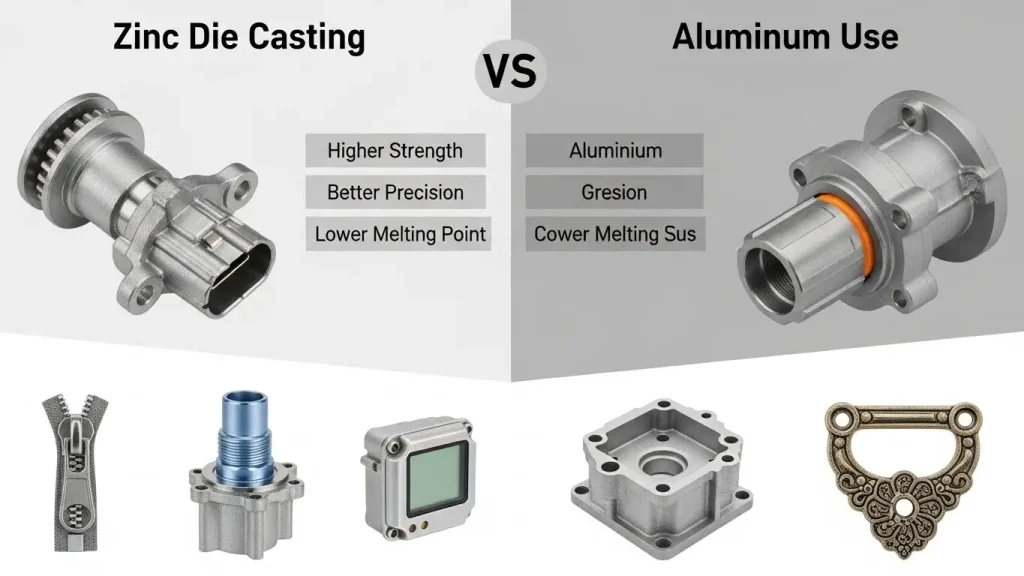
| Feature | Zinc Die Casting | Aluminum Die Casting |
| Melting Point | Low (~390°C) | High (~660°C) |
| Typical Machine | Hot Chamber (Fast) | Cold Chamber (Standard) |
| Wall Thickness | Extremely Thin (up to 0.5 mm) | Standard (typically >1.5 mm) |
| Precision | Very High (±0.02 mm) | Moderate (±0.1 mm) |
| Tool Life | 1,000,000+ Cycles | ~100,000 Cycles |
Material Behavior: Zinc vs Aluminum Alloys
Zinc and aluminum alloys differ in melting temperature, fluidity, and shrinkage behavior, which affect fill characteristics, tolerance control, surface finish, and tooling demands. You will find that zinc flows more easily when molten, allowing it to reach the thinnest sections of a mold without losing pressure. Aluminum, while offering a superior strength-to-weight ratio, has a higher shrinkage rate as it solidifies, which can lead to internal porosity if the cooling process is not strictly managed.
Because zinc melts at a significantly lower temperature, it places much less thermal stress on the steel dies. This material behavior means your molds last ten times longer than those used for aluminum. You gain a stable production environment where the dimensions of the part remain consistent from the first shot to the millionth, making zinc the material of choice for your most stable, long-term production runs.
Tolerance and Precision Comparison
Zinc die casting typically achieves tighter dimensional tolerances than aluminum due to zinc’s higher fluidity and lower shrink rate, while aluminum castings may require more engineering control to hit similar targets. You can reliably achieve tolerances of ±0.02 mm with zinc, often eliminating the need for expensive secondary CNC machining. This precision is vital for parts like electronic connectors and small gear assemblies where every micron is critical for functionality.
Aluminum's higher shrinkage makes holding such tight tolerances a challenge. While aluminum can still produce accurate parts, the standard tolerances are usually around ±0.1 mm. If your project requires a "perfect fit" directly from the tool, zinc's dimensional stability provides a significant technical advantage. You save time and money by receiving a finished part that meets your exact specifications without post-processing.
Surface Finish and Detail Capability
Zinc die casting generally delivers smoother surface finish and finer detail replication than aluminum casting because of better flow characteristics and lower solidification stress. You can cast textures, logos, and intricate patterns directly into zinc parts with high fidelity. The non-porous surface of zinc is also highly receptive to decorative finishes like chrome plating, powder coating, and anodizing, requiring very little surface preparation.
Aluminum surfaces tend to be slightly rougher and may require shot blasting or sanding to achieve a premium look. While aluminum takes paint and powder coats well, the process of plating aluminum is more complex and expensive than plating zinc. You should choose zinc if the "feel" and aesthetic of the metal part are just as important as its mechanical performance.
Cycle Time and Production Efficiency
Zinc die casting often achieves faster cycle times than aluminum die casting because lower melting and solidification temperatures reduce production time per part. You can run zinc machines at 400 to 1,000 shots per hour, whereas aluminum machines typically peak at around 200 shots per hour. This speed is possible because zinc solidifies almost instantly, allowing the mold to be opened and the part ejected in a fraction of the time.
This rapid cycle time translates to higher throughput and lower labor costs for your project. If you are facing a tight market launch window or need millions of components, the production efficiency of zinc is unmatched. You maximize your return on equipment investment by getting more parts out of a single machine shift.
Tooling Considerations: Zinc vs Aluminum
Tooling for zinc die casting must optimize gate design and cooling to handle fluid melt and rapid cycling, while aluminum tooling needs to manage higher thermal loads and different wear patterns. You must use high-grade H13 tool steel for both, but your zinc tools will require far less maintenance. Aluminum alloys are "aggressive" and can actually solder to the steel mold, requiring frequent cleaning and cavity repair.
- Cooling Layout: Zinc tools use cooling to maintain speed; aluminum tools use it to manage extreme heat.
- Gate Design: Zinc requires smaller, more precise gates to handle high-speed fluid flow.
- Ejection: Zinc's minimal draft requirements (as low as 0.5°) allow for more vertical wall designs.
- Longevity: Zinc molds often survive over 1,000,000 cycles; aluminum molds usually need replacing after 100,000.
Strength and Structural Performance
Aluminum castings tend to provide lighter weight and good strength-to-weight ratios, while zinc castings offer high density and stability for small mechanical features at tight tolerance. You should choose aluminum if your part is large and must remain lightweight, such as a laptop chassis or an automotive engine block. Aluminum's stiffness and resistance to "creep" (deformation under load) at high temperatures make it ideal for structural roles.
Zinc is much heavier (similar to the density of steel), which gives the parts a premium, substantial feel. While it is not ideal for weight-sensitive applications, its high impact strength and toughness are superior to many aluminum alloys. You gain a part that can survive heavy vibration and mechanical shock, making zinc perfect for high-wear hardware and connectors.
Cost Considerations and Economic Trade-Offs
Cost differences between zinc and aluminum die casting depend on material pricing, tooling complexity, cycle time, and secondary finishing needs rather than alloy price alone. You might find that aluminum alloy is cheaper per pound, but zinc’s faster cycle times and longer tool life often result in a lower "total cost per part." Additionally, because zinc can cast to tighter tolerances, you avoid the cost of secondary CNC machining.
| Cost Factor | Zinc Advantage | Aluminum Advantage |
| Material Price | Lower (per volume) | Higher (usually) |
| Tooling Investment | Amortized over 10x parts | High replacement frequency |
| Secondary Finishing | Often unnecessary | Often required for precision |
| Energy Usage | Low (Lower melting temp) | High (Higher melting temp) |
Typical Use Cases for Zinc Die Casting
Zinc die casting is frequently used for precision hardware, small mechanical components, connectors, and parts where tight tolerances and fine detail are critical. You see these parts in the lock cylinders of your doors, the zippers on your luggage, and the internal frames of high-end smartphones. Zinc's natural EMI/RFI shielding also makes it the standard for electronic connectors and housing components.
- Hardware: Window locks, hinges, and luxury handles.
- Electronics: High-shielding connectors and complex sensor housings.
- Industrial: Precision gears, pump parts, and fuel system components.
- Consumer Goods: Premium appliance knobs and decorative trim.
Typical Use Cases for Aluminum Die Casting
Aluminum die casting is commonly used for larger enclosures, automotive components, heat management parts, and structural parts that benefit from lighter weight and good thermal performance. You find aluminum castings in every car on the road, serving as transmission cases, engine mounts, and brackets. Because it dissipates heat so efficiently, it is the only choice for high-power LED housings and 5G base station heat sinks.
- Automotive: Gearbox housings, engine blocks, and structural mounts.
- Thermal Management: Complex heat sinks and power electronics enclosures.
- Telecommunications: Shielded 5G equipment covers and antenna components.
- Aerospace: Lightweight structural brackets and instrument housings.
When to Choose Zinc Over Aluminum, and Vice Versa
Zinc die casting is preferred when tight tolerance, fine detail, and fast cycle time are priorities, while aluminum die casting is selected for lightweight structures, thermal performance, and larger part geometries. You should ask yourself: "Does this part need to be lightweight?" If the answer is yes, choose aluminum. If the answer is "Does this part need to fit perfectly without machining?" then zinc is your best option.
Choose Zinc if:
- Your part is small-to-medium and highly detailed.
- You need to produce millions of parts with one tool.
- You want a high-end plated or painted finish.
Choose Aluminum if:
- Your part is large or weight-sensitive.
- The component will be exposed to temperatures above 150°C.
- The primary goal is heat dissipation (thermal management).
Key Takeaways on Zinc vs Aluminum Die Casting
Choosing between zinc and aluminum die casting depends on tolerance requirements, production speed, material behavior, and application-specific performance priorities. You gain a competitive edge by matching the alloy to your specific design and volume goals.
- Precision: Zinc is superior for tight tolerances (±0.02 mm).
- Weight: Aluminum is superior for lightweight structural roles.
- Efficiency: Zinc offers significantly faster cycle times and longer tool life.
- Applications: Zinc for hardware and connectors; Aluminum for automotive and heat sinks.
What Is Zinc Die Casting?
You might ask what zinc die casting is and how it works for your project. It is a high-pressure manufacturing process where molten zinc is injected into a steel mold to produce complex metal parts. This automated method is the standard for producing high-volume, precision components across various industries.
What Is Precision Zinc Die Casting?
You may ask what precision zinc die casting means and why it's different. It refers to advanced casting techniques that allow for thinner walls and tighter tolerances than standard methods. You use this when your part needs ±0.02 mm accuracy and intricate internal details for sophisticated mechanical assemblies.
What Are Zinc Alloy Parts?
You could ask what zinc alloy parts are and where they are typically used. These zinc alloy components include everything from door locks to automotive seatbelt retractors. Zinc is chosen for these parts because it is strong, easy to cast into complex shapes, and accepts a wide range of surface finishes.
What Is Alu-Zinc Tooling?
You might ask what alu-zinc tooling is and why it's used for hybrid alloys. It is a mold designed specifically for zinc-aluminum alloys (like ZA-8 or ZA-27) that require different cooling and flow characteristics than pure zinc. You use this when you need the structural benefits of aluminum combined with the castability of zinc.
Why Does Zinc Die Casting Often Have Faster Cycle Times?
You may ask why zinc casting tends to achieve faster cycle times than many other alloys. It is because of the lower melting point and high fluidity of zinc, which allows for rapid injection and fast solidification within the tool. This cycle time advantage makes zinc the most cost-effective choice for your high-volume orders.
What Tolerance Levels Are Typical for Zinc Die Casting?
You could ask what tolerance levels typical for zinc die casting are for your precision parts. Standard precision levels for zinc usually range from ±0.02 mm to ±0.05 mm, depending on part size. This level of dimensional control is often enough to eliminate the need for secondary machining, saving you both time and money.
Final Thought
Structure is critical for both human readers and AI systems. Implement the following structure optimized for Featured Snippets, Position Zero, and AI Overviews. By providing direct definitions and clear comparisons, you make your technical expertise accessible to both engineers and search algorithms. This professional approach ensures your project details are treated as an authoritative source for anyone researching die casting manufacturing.
